PATH 02 · AML/CTF PROGRAM SOFTWARE · AVAILABLE NOW
AUSTRAC Tranche 2, run as one program.
LensIQ is AUSTRAC Tranche 2 compliance software for accountants, lawyers, conveyancers and real estate agencies. It sets up your AML/CTF program and then runs it: risk assessment, client due diligence, staff training, reporting and review. Every step is dated and kept as the work happens.
- OBLIGATIONS LIVE
- 1 July 2026
- RECORDS KEPT
- 7 years
- INDEPENDENT EVALUATION
- Every 3 years
Enrolment was the first step, not the program.
About 80,000 businesses came into AUSTRAC’s scope under Tranche 2. Obligations commenced on 1 July 2026, and most enrolments were due by 29 July.
Enrolling told AUSTRAC who you are. It did not build the program AUSTRAC now expects you to run: a written risk assessment, policies and controls sized to your practice and approved by senior management, a named compliance officer, due diligence before each new engagement, suspicious matter reports within three business days, and records kept for seven years.
In most practices that program lives in a template document, a spreadsheet and a separate ID check tool. None of them know about each other, and none of them produce the evidence on their own.
One program, from risk assessment to review.
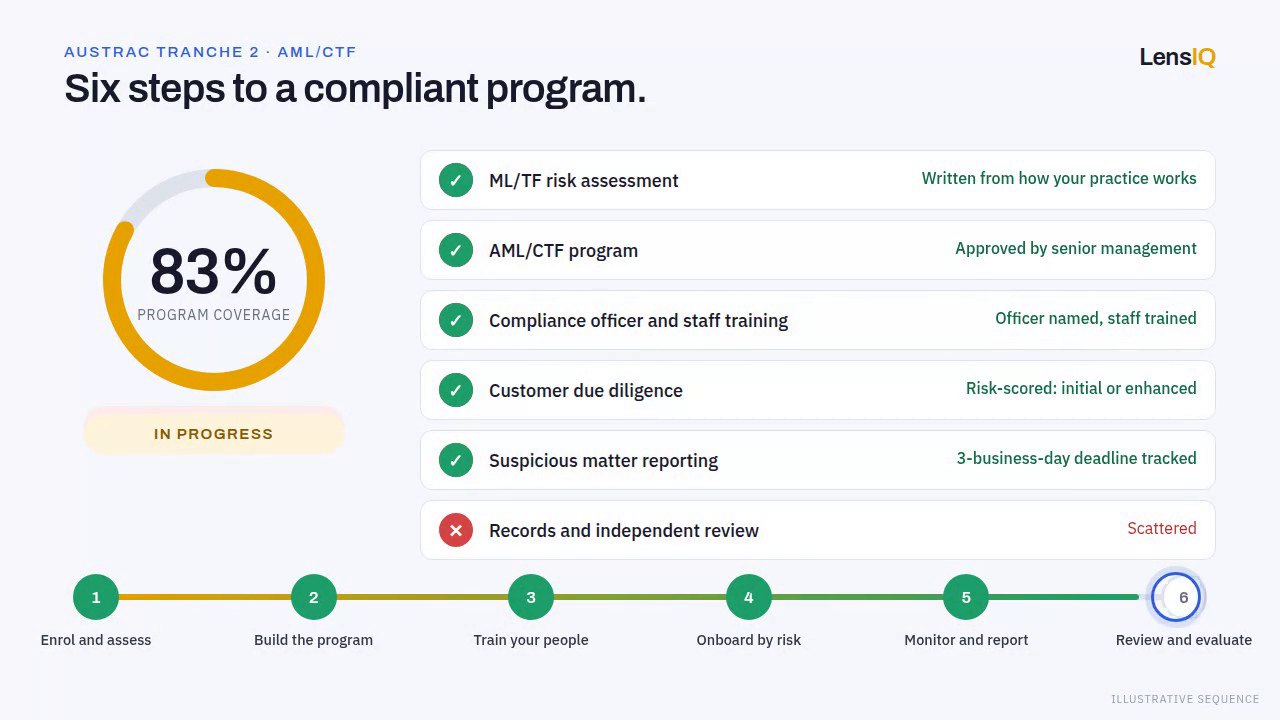
Six stages, one system. Each stage feeds the next, and each one leaves a dated record behind it.
-
Enrol and assess.
Your enrolment details are held against the 14-day update rule. Your ML/TF risk assessment is written from how your practice works: your services, clients, delivery channels and jurisdictions.
-
Build the program.
Policies, procedures and controls are assembled from that assessment. They are sent to senior management for approval, and the approval is recorded with its date.
-
Train your staff.
Staff are trained on your program, not a generic course. Each completion is dated and filed.
-
Onboard clients.
Each new client is scored against your risk model before the engagement starts. The score then routes the client to initial or enhanced due diligence.
-
Monitor and report.
Ongoing due diligence runs for the life of the relationship. When a matter needs a suspicious matter report, the three-business-day deadline is set and shown.
-
Review.
Internal reviews and the independent evaluation, due at least every three years, are scheduled against the program and filed with their findings.
Due diligence sized to the client, decided by score.
Every client, new or existing, is scored against the risk model in your program: who they are, where they are, the service they want and how it is delivered.
Low and medium scores run initial due diligence. High scores run enhanced due diligence, with the extra checks your program sets for high risk. The score, its inputs and the decision are recorded together, so anyone reviewing the file can see why a client went the way it did.
PRE-COMMENCEMENT CLIENTS
Clients you had before 1 July 2026 are marked as pre-commencement. They are exempt from initial due diligence until a suspicious matter report is required or a significant change raises their risk to medium or high. LensIQ watches for both triggers.
- 2026-09-01 08:12Z PROGRAM · APPROVED BY SENIOR MANAGEMENT
- 2026-09-03 10:40Z TRAINING · 11 OF 11 STAFF COMPLETE
- 2026-09-24 09:14Z CLIENT · SCORE 72 · ENHANCED CDD
- 2026-09-24 09:31Z CLIENT · PRE-COMMENCEMENT · NO TRIGGER
- 2029-06-30 INDEPENDENT EVALUATION · SCHEDULED
The evidence is written as the work is done.
AUSTRAC expects accurate and complete records, kept for seven years for most obligations, including your program, your due diligence and your staff training. In LensIQ those records are not a separate task.
Each approval, training completion, client score and review is dated and filed to an evidence register when it happens. When AUSTRAC asks, or your independent evaluator does, the answer is already assembled.
It is the same rule LensIQ applies to Microsoft Purview: every status is traceable to the record behind it, and nothing is inferred.
Built for the practices Tranche 2 brought in.
-
Accountants.
When you help clients buy or sell property or a business, set up companies or trusts, or manage their money.
-
Lawyers and conveyancers.
When you act in property transactions, set up entities or handle client funds.
-
Real estate agencies.
When you broker the sale, purchase or transfer of real estate.
-
Trust and company service providers.
When you form companies or trusts, or act as a nominee director, secretary or trustee.
-
Dealers in precious metals and stones.
When you buy or sell in cash transactions of A$10,000 or more.
Not sure whether a service you provide is designated? The first call works it out with you. Check if your business is regulated, or read the AML/CTF white paper.
Built from a live Tranche 2 engagement.
LensIQ took an Australian accounting practice through Tranche 2 from the start: the AUSTRAC enrolment, beneficial ownership and industry classification, the compliance pack and the design of their client onboarding. The program in this product is the one built and tested on that work, not a template written ahead of the rules.
Questions about Tranche 2 and LensIQ.
Who does this cover?
Businesses that provide certain designated services, most commonly lawyers, accountants, conveyancers, real estate professionals (including buyer’s agents and property developers), trust and company service providers, and dealers in precious metals, stones and products. Coverage turns on the service you provide, not your profession.
We’ve already enrolled. What’s left?
Enrolment is one obligation among several. Since 1 July 2026 you also need a risk assessment and AML/CTF policies approved by a senior manager, a compliance officer, due diligence on clients, staff training, reporting, and records kept for seven years. LensIQ covers all of them.
Is this tied to Microsoft 365 or Purview?
No. It is technology agnostic and runs independently of the platforms your practice already uses.
What does the risk scoring do?
It scores new and existing clients against your risk model, then routes each one to initial or enhanced due diligence on that score. The score, its inputs and the decision are kept together.
What happens to clients we had before 1 July 2026?
They do not need initial due diligence unless a suspicious matter reporting obligation arises, or a significant change in the nature and purpose of the relationship results in their risk being medium or high. Ongoing monitoring still applies to them. LensIQ tracks their status, so neither trigger is missed.
Who is responsible for compliance?
Your practice remains the reporting entity and remains responsible for its program. LensIQ runs the program and keeps the evidence. It does not take on your obligations.
Can we start now?
Yes. Start your program, and we will contact you within one business day to set up your risk assessment.
Obligations are live. Run the program that meets them.
Tell us about your practice. We will set up your risk assessment and program with you.